Frontend
Vanilla JavaScript, zero build. One page.
List the dishes you eat on repeat. Get one new recipe tuned to how far you're willing to stretch — new to you, but a plausible hit.
Keep the wide-noodle, saucy comfort you already love; move it to a smoky Thai stir-fry.
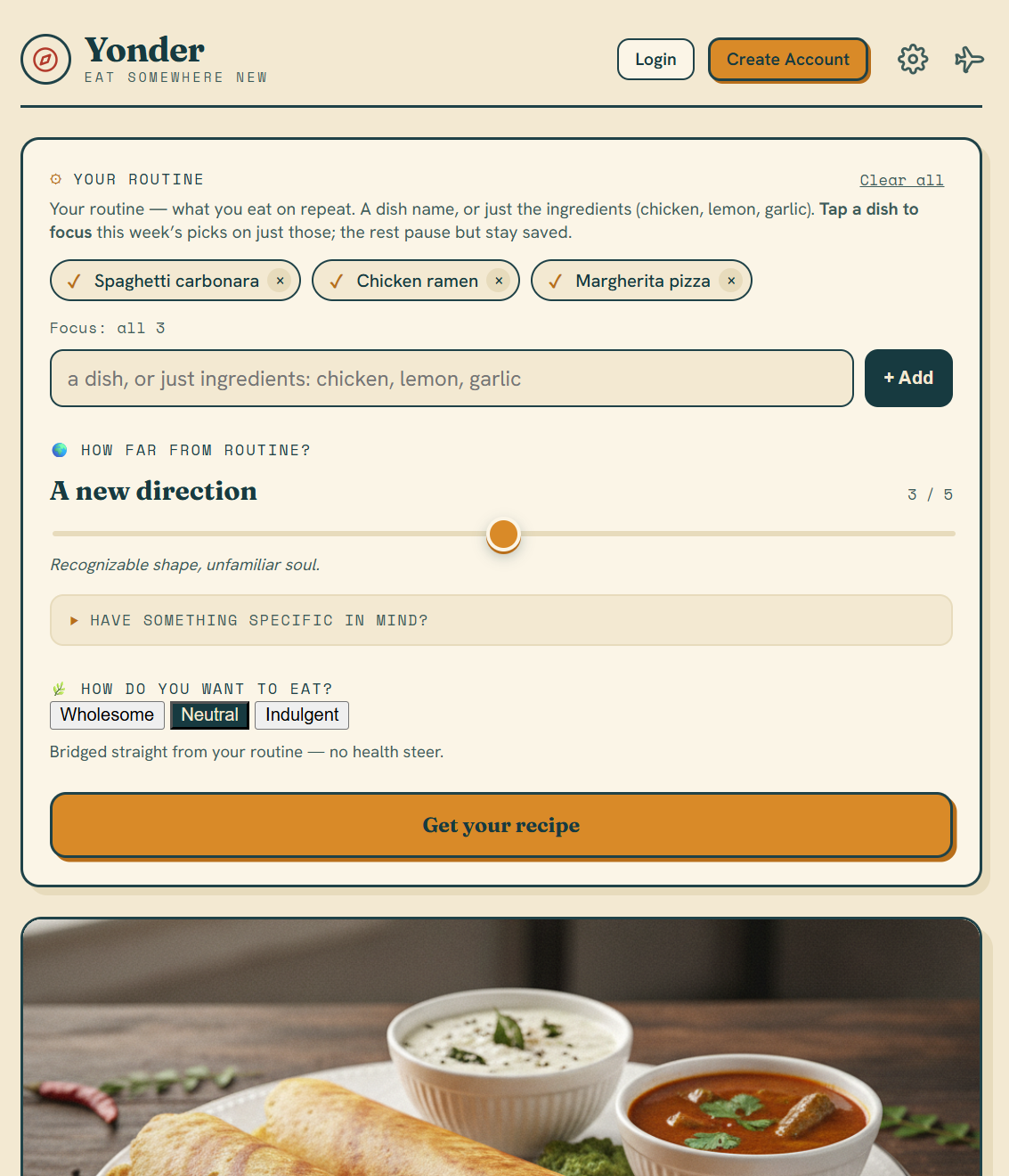
You list what you actually cook on repeat. It returns one new dish at the distance you choose, grounded in a 2,476-recipe corpus of tested recipes, with a short bridge explaining why the leap is worth taking. Most recipe apps optimize for fit — more of what you already eat — or bury you in options until discovery is a research project. This does neither.
Most recipe apps fail one specific person: someone who likes to cook, is tired of the same rotation, but won't risk an evening on a recipe that flops. Fit-optimizing apps show more of the same. Option-dumping apps turn dinner into research. Neither moves the person out of the rut without a gamble. Yonder is built for that person: measured novelty, not maximum choice.
List what you actually eat on repeat. Get back a single destination — one new dish, tuned to the distance you set:
React with one tap — would I make this? — and the next pick tunes to that.
The engine optimizes for calibrated distance rather than fit. The design goal is a contradiction held on purpose: never gamble on a recipe that misses, never stop growing your range. A distance dial (1–5) sets the leap size; mood and focus shape the pick without touching that distance.
Hard constraints are absolute — allergies are never served, diet is a hard filter, equipment is a can-you-cook-it gate, and the leap stays inside the meal slot. Picks come from the 2,476-recipe corpus; the model serves an improvised sketch only when nothing fits the calibrated distance, and labels it as one. A guess never masquerades as a tested recipe.
It deploys into the edge and stays cheap to run:
The whole thing runs serverless on Cloudflare. No container fleet to babysit — the deployment judgment that matters when something has to run unattended.